
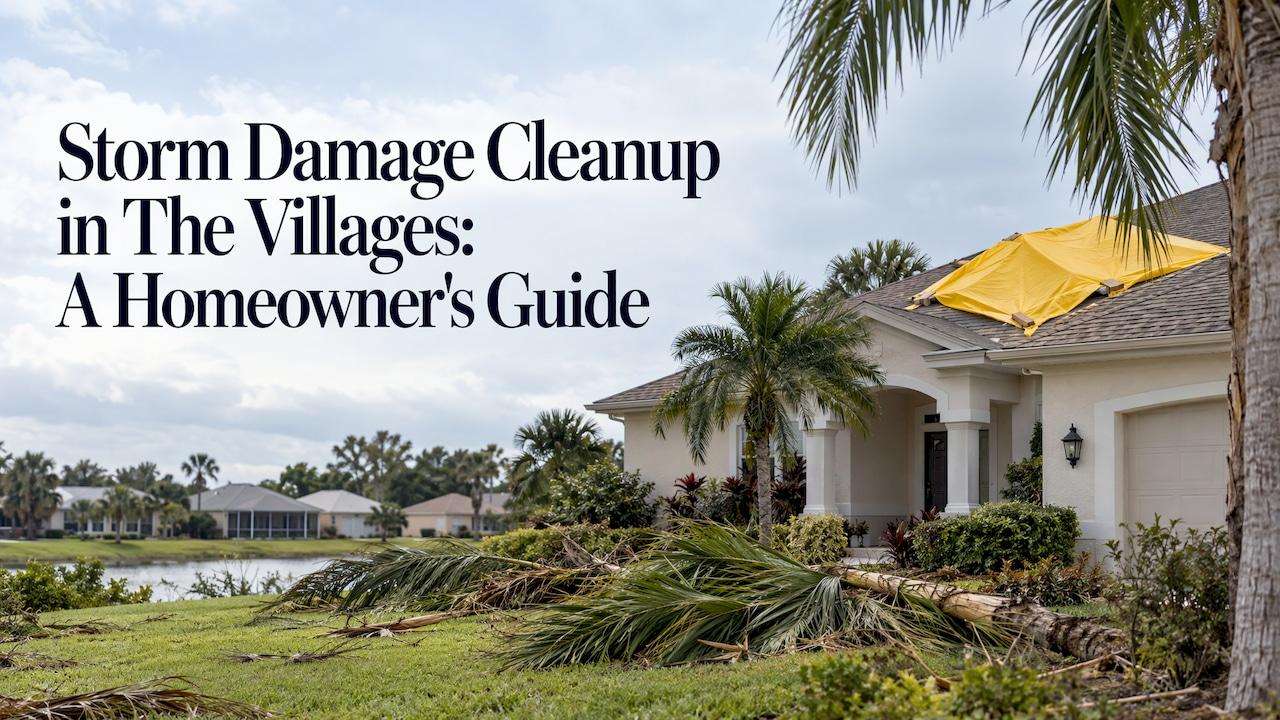
After a storm, the safest cleanup is the one done in the right order: check the house for hazards, document everything, then clear water, debris and damaged belongings. The heavy, repetitive parts are where people get hurt. In The Villages, a VillagePro membership covers hurricane preparation and cleanup, heavy lifting, lawn care, pool and lanai care and handyman repairs through local, vetted professionals under one flat monthly fee. You don't have to coordinate a different crew for each job.
This guide covers what to do in the first hours, how to document damage for your insurer, how to clean safely, who is responsible for debris and what to hand off.
TL;DR
- Don't go in until you've checked outside for downed power lines, gas smells and structural damage. Nearly half of hurricane deaths happen after the storm.
- Photograph and video everything before you clean, move or throw anything away, then call your insurer.
- Debris on private property is the owner's job. FEMA doesn't reimburse homeowners for it, and curbside pickup only runs during a set window.
- Wet materials need to be dry or removed fast, because mold starts quickly.
- Bulky lifting, yard debris and repeat visits are what a VillagePro membership takes off your hands, so you don't have to do them yourself.
Table of Contents
- First hour: make the house safe to enter
- Document the damage before you touch anything
- Cleaning up inside: a sequence that works
- Storm debris: who is responsible for it?
- What to do yourself and what to hand off
- How a VillagePro membership fits into storm recovery
- Before the next storm: prepare so cleanup is smaller
- FAQ
- Sources
First hour: make the house safe to enter
The storm may be over, but the danger isn't. Before you open the door, walk the outside. The Red Cross says to look for loose power lines, broken gas lines, foundation cracks and missing support beams before you go in. If a door is jammed, don't force it. If you smell gas, leave right away and call the fire department.
A few more rules from the same guidance:
- Use a flashlight if the power is out, never a flame.
- Tap loudly on floors as you walk in, to warn off animals.
- Don't lean on damaged walls, railings or stairs.
- If you see frayed wiring, sparks or a burning smell, shut off electricity at the main breaker. If you smell gas or see a broken line, shut off the main gas valve from outside. Only a professional can restore gas service.
If water got inside, have an electrician check the house before you restore power. OSHA says not to work in or around a flood-damaged building until a registered professional engineer or architect has certified it safe. That is a safety step, not a formality.
Protect yourself while you work
Cleanup is hot, heavy and dirty. OSHA's guidance is to wear watertight steel-toe boots, gloves, long pants and safety glasses, never sneakers. Use a NIOSH-approved dust respirator around moldy materials. For bulky objects, work in teams of two or more and avoid lifting more than 50 pounds per person.

Florida's heat adds to the strain. NOAA advises cleaning up slowly, staying hydrated, wearing light, loose clothing and working in the cooler hours. It also asks you to check on elderly and vulnerable neighbors.
FEMA's guidance is blunt about this. Even the first assessment and salvage can be hot, heavy work, and shock and physical effort are often underestimated. It advises avoiding entry, even with protective gear, if you have asthma or allergies, heart problems, a weakened immune system or open cuts. If that describes you, or you are a snowbird living out of state, the better plan is to let someone else do the entering and lifting. That is the situation our senior assistance and snowbird home watch services were set up for.
Document the damage before you touch anything
Your insurance claim is built on what you can show. The National Flood Insurance Program says to photograph and video the damage before cleaning, fixing or discarding anything. Take wide shots and close-ups of walls, floors and furniture. Photograph serial numbers on damaged electronics and appliances, and keep small samples of damaged materials and your receipts.
FEMA adds a few practical habits:
- Take photos from different corners of each room.
- Use time and date stamps.
- Write down the dates of your visits.
- Save samples of valuable contents such as carpet.
And photograph the make, model and serial number of appliances and save every repair receipt.
The Better Business Bureau advises contacting your insurer right away, and limiting repairs to temporary measures such as tarping a broken window or roof until the insurer approves permanent work. Keep every receipt.
You do not have to wait for a FEMA inspection to start. FEMA says residents don't need to wait for a home inspection or insurance claim inspection before beginning cleanup and repairs. Check for structural damage first, and report it to local officials.
Cleaning up inside: a sequence that works
The Red Cross summarizes the process in a few steps. If the home has been closed up for more than 48 hours, air it out before staying inside. Then work in this order:
- Remove standing water, mud and damaged items. Pump out a flooded basement gradually, about one-third per day. Florida homes rarely have basements, but the same logic applies to a flooded garage or lanai.
- Clean hard surfaces. Use hot water and soap or detergent, then disinfect with bleach or a commercial disinfectant.
- Dry soft items in open air before trying to clean them.
- Throw out food, drinks and medicine that touched floodwater or mud. That includes canned goods and sealed containers.
- Have inundated appliances checked by a professional before you use them.
The EPA's four-part framing is easy to remember: stay safe, sort what you can't clean and dry, clean everything wet or moldy, and dry everything completely. It recommends a gentle first cleaning with a cloth dampened in clean water and detergent, and avoiding stirring up dust. It also says to wait to run fans or dehumidifiers until visible mold has been gently cleaned, so the fans don't spread it.
Why speed matters: mold
Dampness feeds mold, bacteria and pests. A federal consumer guide on post-disaster restoration boils it down to four goals: get it safe, dry, clean and pest-free. It recommends wearing a respirator with HEPA cartridges, or rated N-95 or higher, whenever mold or bacteria are present.

There is also an insurance angle. NFIP policies do not cover mold damage, so start drying out damaged items as soon as you safely can. FEMA also says to remove all drywall and insulation that touched floodwater.
Storm debris: who is responsible for it?
After a hurricane, the yard is often harder to deal with than the house. Palm Beach County's emergency management office explains the rule plainly: debris on private property is the owner's responsibility. Insurance and volunteer agencies can help. Within a time frame set with FEMA, owners may move disaster debris to the curb for pickup by an eligible local or state government.
FEMA itself says it does not directly remove debris, hire cleanup crews or run dump sites. It funds governments, and local officials decide where debris goes and who collects it. The same county summary says FEMA does not reimburse private owners for clearing debris from their own property.
So, will FEMA pay for storm cleanup? Not for debris removal on your lot. A 2023 hurricane resource guide from Congressman Neal Dunn's office describes FEMA Individual Assistance for cleaning and sanitizing a home, including mold-related repairs. It also says that help complements private recovery and isn't a loss indemnification program. Whether it applies depends on the disaster declaration, so check the current rules for your county.
What happened after Hurricane Milton
The Villages spans parts of Sumter, Lake and Marion counties, and each runs its own collection. After Hurricane Milton in 2024, Sumter County said its contractor was removing debris and that residents should expect it to take weeks. The same report says nearby Leesburg asked residents to separate vegetative debris from bulky items. It also said tree debris must be under 6 feet long and 12 inches in diameter.
The pattern to expect is this:
- Piles sit at the curb for days or weeks.
- Collection rules differ by county and city.
- The details change with each storm.
Check your county's current notice for pile sorting and pickup dates before you drag anything to the street.
Watch for storm-chasing scams
Florida's Department of Elder Affairs warns that after storms, scammers may pose as FEMA workers, tree-removal crews or debris-removal contractors. They use urgency and pressure to get payment up front. Never pay a stranger who knocks on your door. The NFIP checklist says to hire only licensed, bonded and insured companies and to get written estimates.
Neighbors you already know and a service you already belong to take this risk off the table. You know who is coming and what the arrangement is.
What to do yourself and what to hand off
Some jobs are fine for a careful homeowner. Others are not.
| Task | Reasonable to do yourself? | Why |
|---|---|---|
| Photographing damage | Yes | You need the originals for the claim |
| Bagging small debris, light cleanup | Yes, with gloves and sturdy shoes | Low risk if you pace yourself in the heat |
| Moving heavy limbs, furniture, wet carpet | Better handed off | OSHA says to avoid lifting more than 50 pounds alone |
| Entering a damaged structure | Only after it is cleared | A structural check comes first |
| Electrical or gas restoration | No | Needs an electrician or utility |
| Moldy materials | Only with a proper respirator, or handed off | Dust and spores are a health risk |
| Hauling debris to the curb | Better handed off | Piles are heavy and often too long for your cart or car |
For flooded homes with widespread contamination, the EPA says it may be best to get help from experienced, qualified professionals. These include professionals who can judge whether a home is safe to enter or whether cleanup is complete. Look for credentials from NEHA, AIHA, IICRC or ACAC, and check training, experience and references.
How a VillagePro membership fits into storm recovery
The hardest part of storm recovery is that everything lands at once. There is a yard full of limbs, a lanai that needs clearing, a screen door off its track, and a schedule full of calls. Most people in The Villages don't want to manage a lawn crew, a handyman and a hauler as three separate relationships.
VillagePro is a home-services membership for Villages residents. It covers hurricane preparation and cleanup, heavy lifting, lawn care, pool and lanai care, handyman repairs, assembly, golf cart care and errands and grocery runs. Our professionals are local and vetted. You can request service by call, text or online, and plans include scheduled visits with options for priority or emergency scheduling and a dedicated service professional. There are no contracts, no hidden fees and no markups on parts. Parts are charged at cost, and larger projects get discounted quotes.

If you want storm cleanup, repairs and yard work handled by one team, see our home repairs and seasonal maintenance memberships. Our 100% happiness guarantee applies to members.
Before the next storm: prepare so cleanup is smaller
Most of the cleanup burden is decided before the storm arrives. A few habits make a real difference:
- Walk the yard in advance. Loose items and overgrown trees turn into debris and projectiles.
- Photograph your home and contents now. A baseline makes later claims easier to support.
- Keep a folder of insurance numbers, receipts and appliance serial numbers.
- Decide who will check on you. NOAA's advice to look in on elderly and vulnerable neighbors only works if someone has you on their list.
- Arrange home watch if you travel. Snowbirds who leave for the summer are away during hurricane season. Our snowbird home watch is part of the membership.
Preparation is also part of the service. Hurricane preparation is one of the things our membership covers, so the yard and lanai can be made ready before the season gets busy.
FAQ
Who is responsible for cleaning up after a storm?
For your own property, you are. FEMA doesn't remove debris itself or reimburse private owners for it. It funds local governments, which decide where debris goes and how it is collected. Your insurer may cover some damage, so call them early.
Will FEMA pay for storm cleanup?
Not for removing debris from your own lot. Eligible governments may collect disaster debris from the curb during a set window. FEMA Individual Assistance can sometimes help with cleaning and sanitizing a home after a declared disaster, but it is not a substitute for insurance. Check current eligibility for your county.
Should I take photos before or after I clean up?
Before. The NFIP advises photographing and filming damage before cleaning, fixing or discarding items. Include serial numbers on appliances and keep samples of damaged materials and all receipts.
How soon do I need to dry out a flooded home?
As soon as it is safe, because mold grows in damp materials. The EPA says to dry everything completely, and to gently clean visible mold before running fans so they don't spread it. Federal guidance also says to remove wet materials that cannot be dried quickly.
Can I start repairs before the adjuster visits?
You can start cleanup and temporary protection. The BBB says to limit repairs to temporary measures like tarping until the insurer approves permanent work, and to keep every receipt.
Sources
- Checking Your Home's Structure, American Red Cross
- Disaster Cleanup & Repair For Your Home, American Red Cross
- Flood Recovery Checklist, National Flood Insurance Program
- Document Flood Damage, National Flood Insurance Program
- Use Caution After Storms, NOAA
- Safety Guidelines: After a Tornado, CDC
- Cleanup Hazards, OSHA
- The ABC's of Returning to Flooded Buildings, FEMA
- Don't Wait to Clean Up or Make Repairs, FEMA
- Frequently Asked Questions About Disasters, FEMA
- BBB Tip: What to do after a damaging storm
- Flood Cleanup to Protect Indoor Air and Your Health, EPA
- Consumer Tips for Post-Disaster Home Restoration
- Debris Removal Federal Guidelines, Palm Beach County Office of Emergency Management
- 2023 Hurricane Resource Guide, Congressman Neal Dunn
- Post-Hurricane Milton debris removal efforts, 352today
- Free Scam Alerts offered by Department of Elder Affairs, News4Jax